de alchemia cybernetica
quod est superius…
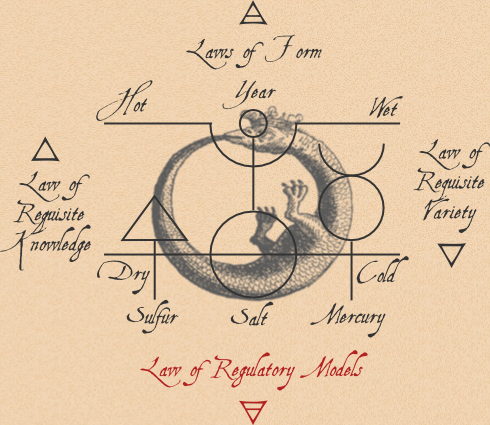
That which is above is as that which is below, and that which is below is as that which is above, for the performance of the miracles of the one thing. — The Emerald Tablet.
The Law of Regulatory Models, developed by Roger C. Conant and W. Ross Ashby as the Good Regulator theorem, states that, "every good regulator of a system must be a model of that system" (Conant and Ashby, International Journal of Systems Science, Vol. 1, No. 2, October 1970). Klaus Krippendorff restated it as the Law of Required Model-Regulatory Identity:
This is a stronger version of the law of requisite variety and posits that any regulator able to confine the fluctuations in the system to be regulated must not only have adequate amounts of variety available to control that system but also be or have a homomorphic representation of that system. — Web Dictionary of Cybernetics and Systems
There are two types of models described by those laws. One is more obvious, and is the sort of thing humans do when we "mentally" construct (through languaging) a re/presentation of a system we wish to predict and control, such as weather (controlling the weather can be as simple as opening an umbrella in the rain, which creates more-or-less local conditions as-if the rain had ceased falling; cf. rain dancing, an especially non-local means of controlling weather). A more subtle model is the one that is embodied. When an engineer engineers a climate control system, she makes use of the aforementioned sort of model, to design, say, a thermostat (cf. homeostat). But the thermostat itself must embody a set of states that correspond to the variety of temperatures it is expected to regulate (since it cannot embody all variety without being equally complex as the domain of regulation, the thermostat must "anticipate" or "know" the range of perturbations to operate with-in — cf. the law of requisite knowledge). This is the sort of modeling that an organism embodies when it co-regulates (maintains homeostasis, conserves autopoiesis) itself-with-in-its-environment. "Survival of the fittest is a special case of survival of the stable" (Richard Dawkins, The Selfish Gene; cf. ultrastability).
feedback & feedforward
A note here about feedback and feedforward. Feedback happens where-whenever the perturbation "leaving" the control system is returned to the control system as information about the state of the environment, where-when it is compared to the control system's goal state and the controller's behavior is there-then modified to bring the two (the actual state and the goal state) closer together (notice how the diagram for negative feedback resembles Caduceus). Feedforward happens where-whenever the control system predicts a future state of the environment, and changes its behavior accordingly. The advantage of feedback is that it corresponds to the actual state of the environment. The advantage of feedforward is that it conserves resources by pairing probable environmental states with responses that are known to the controlling system to be adequate in such circumstances. E.g., you can drive a car from point A to point B by reacting to the traffic conditions as you experience them. But if you can predict rush-hour traffic patterns, you can choose an alternative route without having to get stuck in traffic in order to "know better." This example demonstrates that actual knowledge of the system is better than prediction — what if, for whatever reason, there is no rush-hour traffic at the place-time you assumed there would be? — but where-when we cannot have complete knowledge of the system we wish to regulate/navigate/whatever, predictions can help compensate for the complexity of those systems.
Just as magical enchantments adapt over time to bring the magician's actual state closer to her goal state, divinations help the magician to prepare for future or otherwise unknown states. Peter Carroll's advice to "enchant long and divine short" corresponds precisely to how feedback and feedforward behave with respect to time: feedback systems take longer to re-act to actual conditions, and feedforward systems quickly lose their ability to predict long-range changes, especially as the dynamicism of the environment increases (cf. chaotic behavior).
The idea that information can be stored in a changing world without an overwhelming depreciation of its value is false. — Norbert Wiener, The Human Use of Human Beings
microcosm & macrocosm
[…] the universe of the alchemists is organized in a series of concentric spheres, the outermost of which is the macrocosm of the planets and the stars. The macrocosm's pattern rules the microcosms, each of which is a replica of it in small, reproducing its structure. — Andrea Aromatico, Alchemy: The Great Secret
Similar to the idea that there must be homomorphism between a good i.e. viable regulator and the domain regulated, are the macrocosm and microcosm, which again applies to maps in the ordinary sense (as a miniature model of a territory — cf. Borge's map), and in the alchemical sense to correspondences between all things and especially between humans/observers (Microcosm) and the universe/world (Macrocosm) (cf. anthropomorphism and the anthropic principle) — "There is nothing in heaven or earth that is not also in man (Paracelsus, "Concerning the Art of Transformation"). E.g., how the four elements correspond to the four humors, or the aspects of heavenly bodies correspond to human personalities and other terrestrial affairs, in astrology. "As above, so below." Cf. a theory of everything.
Cybernetics is similar [to geometry vis-à-vis ordinary space] in its relation to the actual machine. It takes as its subject-matter the domain of "all possible machines", and is only secondarily interested if informed that some of them have not yet been made, either by Man or by Nature. What cybernetics offers is the framework on which all individual machines may be ordered, related and understood. — Ashby, An Introduction to Cybernetics
In a piece of wood there lie concealed the forms of all animals, the forms of plants of every description, the forms of all instruments; and he who can carve them finds them. — Paracelsus, "Concerning the Art of Transformation"
A related idea (and model) is the meta-system transition, the emergence of multilevel control structures. "Ascendit a terra in coelum, iterumque descendit in terram, et recipit vim superiorum et inferiorum (It ascends from earth to heaven and descends again to earth, and receives the power of the superiors and of the inferiors)" (Emerald Tablet). I.e. control arises from a system to a meta-system, which controls "down" to the original (now sub-)system, real-izing the combined power of both. "Sic habebis Gloriam totius mundi (So you have the glory of the whole world)."
author: joshua madara