de alchemia cybernetica
solve et coagula
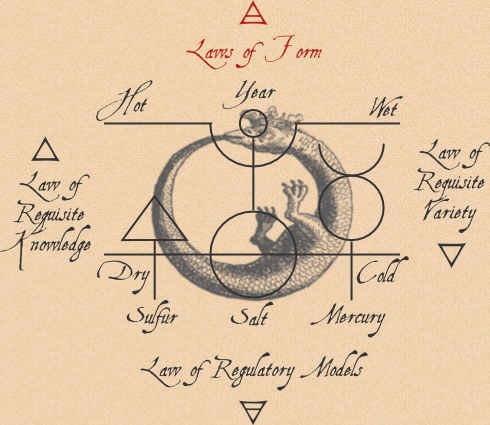
The theme of this book is that a universe comes into being when a space is severed or taken apart. The skin of a living organism cuts off an outside from an inside. So does the circumference of a circle in a plane. By tracing the way we represent such a severance, we can begin to reconstruct, with an accuracy and coverage that appear almost uncanny, the basic forms underlying linguistic, mathematical, physical, and biological science, and can begin to see how the familiar laws of our own experience follow inexorably from the original act of severance. — George Spencer-Brown, Laws of Form
Combinations, wholes and not-wholes, conjunction and separation, harmony and discord — out of all things comes One, and out of One all things. — Heraclitus
The outer and the inner are one thing, one constellation, one influence, one concordance, one duration, one fruit. — Paracelsus, "Concerning the Art of Transformation"
Solution and coagulation, what Jack Courtis called "the alchemical koan" ("Commentaries on the Secret Symbols of the Rosicrucians of the 16th and 17th Centuries").
[…] the [Zen Buddhist] koan, like the alchemical expression or riddle, by virtue of its initial incomprehensibility, forces one to wrestle with it alone, to work it through, to come to terms with it not just by rational explication, but through meditative concentration and inspiration. — Arthur Versluis, Restoring Paradise: Western Esotericism, Literature, Art, and Consciousness
Before Zen, mountains are mountains and rivers are rivers. During Zen, mountains are not mountains and rivers are not rivers. After Zen, mountains are again mountains and rivers are again rivers. — variation of a popular Zen aphorism
The work of alchemy, whether physical, mental, or spiritual, is concerned with trans-forming things in-to other things: lead in-to gold, ignorance in-to knowledge, sickness in-to health, mortality in-to immortality, etc. Operations similar to solution and coagulation — e.g. analysis and synthesis, dissociation and association, separation and mixture, simplicity and complexity, etc. — are boundary phenomena, e.g. where-when we make a distinction from-with-in a unity — distinguishing two or more items, and dissolving the unity — or we combine two or more items in-to a unity, and dissolve the items, or we change our operation from either-or to both-and (cf. quantum superposition), etc. They emerge out-of the connections and distinctions we make and break between things (cf. magical link). Distinction making and breaking is afforded a logical calculus (means of calculation) in George Spencer-Brown's Laws of Form (cf. George Boole's Laws of Thought and set theory). The ability to make correct (i.e. viable) distinctions is the measure of wisdom (cf. divination), and is amplified by the Philosopher's Stone which transmutes all things (cf. enchantment).
The most fundamental concept in cybernetics is that of "difference", either that two things are recognisably different or that one thing has changed with time. […] All the changes that may occur with time are naturally included, for when plants grow and planets age and machines move some change from one state to another is implicit. — W. Ross Ashby, An Introduction to Cybernetics
The process of drawing out and congealing may describe the externalization of an idea from conception to manifestation. Also, in addition to breaking down and (re-)joining (cf. re-pairing, healing, spagyric, panacea), solution may refer to a homogeneous mixture in which the identity of the dis-solved substance is lost (cf. untying knots, solving puzzles), and coagulation may refer to re-inforcing (thickening) a substance (as where-when blood coagulates).
author: joshua madara